
SUZUKI
Legendary vision
APPROACH
Background:
Before the economic opening of 1990, the supply of cars in Colombia was limited, due to the restriction on imports, the automotive fleet was made up of international cars that were manufactured by local assemblers, the brands positioned in the country by then had offered their car models to the Colombian consumer from years, and new brands had a significant space to fill.
Challenge
With the entry of Suzuki to the market selling its models under its own brand, in a market with a lot of dynamism since the economic opening and leaders who produce their cars locally which reduce their costs in tariffs, with a consumer preference for the ease of reselling the car and obtaining spare parts, Suzuki entered the Colombian market to compete in a category in which it had a position usurped by the leader and without the possibility of communicating it directly, in addition to being identified by the consumer as a brand of Motorcycles and not like a car brand.
Insights
Despite the fact that its most famous models have been marketed by the category leader, consumers who really knew the brand's models knew that the car inside was originally a Suzuki, many of them replaced the representative Chevrolet logo with a Suzuki logo.
With that cultural capital we knew that the brand had an opportunity to take advantage of. And we understood the connection that the consumer had with the history of their vehicle, a history that the brand continued to celebrate by not changing the name of its models with the arrival of new generations, as if Renault, Chevrolet or Mazda had done historical leaders of the category in the market.
Strategy:
With that in mind, we created a strategy in which it was established in a natural way how the brand had created models with the ability to stay in time, and we explored the tension between the brand's vision to create cars with such a strong cultural capital, that they had the ability to leave with their models a legacy in the memory of Colombians.
EXECUTION
INSTITUTIONAL CAMPAIGN
Inherit the Future
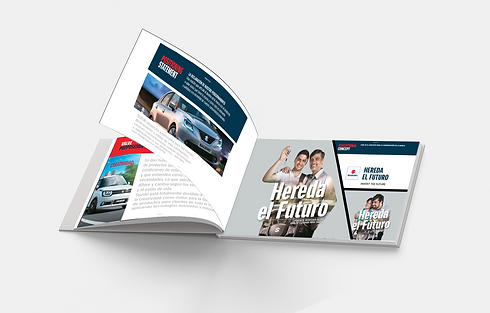
Legendary Visionary's strategic concept was translated into Inherit the Future as a Creative Concept. And it was reflected in the first institutional campaign of the brand in Colombia. Commercials for film and television, newspaper and magazine ads, and adaptations for digital channels, especially YouTube and Facebook Ads.
The campaign worked especially to give Derco the Official representative of Suzuki in Colombia, a way to connect the brand with the sales force of all Derco dealers around the country. Presenting a Brandbook with the brand's history and all the strategic approach that the brand seeks to develop.
BRAND FOOTPRINT


PRINTS


FILM
CAMPAIGNS
In parallel with the institutional campaign, the strategic concept helped to develop the brand in the Colombian market, we carried out different campaigns based on the brand's portfolio.
Each car model in the Suzuki portfolio had a concept that was connected with the concept of the brand, helping to energize the brand idea, each one focused on the different target groups and the needs it covers, showing the versatility of the concept and the ease with which the brand and its different car models could appropriate the brand territory.
 |  |  |  |  |
|---|---|---|---|---|
 |
TOP CAMPAIGNS
SUZUKI SWIFT
There are things I bet you will repeat
The most relevant case for applying the brand idea to a product campaign comes from a car model produced by Chevrolet but designed by Suzuki. The Suzuki swift GTI or Twincam as they nicknamed it, was an icon in Colombia during the 90s. Its unique technology and sporty design made it the fastest car of its generation and a hot hatch of its time.
Suzuki, despite having released new swift models, did not take advantage of the iconicity in its communication, probably because its design stopped being a coupe model to become a hatchback. But with the sports model, the Japanese house managed to retake its essence and recreate the sports DNA with all the technology of the present.
With the reincorporation of these characteristics, the brand was able to revive the icon, bringing to consumers the nostalgia of the past with the technology of the future, giving its followers a second chance to relive the experience of the icon that marked their youth.
The strategy tagline was used for the communication campaign as a statement about all "the things that are worth to be revived".
The campaign took advantage of the connection of the target market with the successful web series the contemporary adult, which recreates different characteristic situations of passing into adulthood. Introducing an episode with all the memories that consumers had with the car and the chance to experience it again through the new model.
TV and radio spots, press advertisements and playlists on Spotify formed the media mix for this campaign.


SUZUKI IGNIS
Far a way of being small
Suzuki's marketing strategy sought to use the old models for the bulk of the market, and the new models to attract new segments.
Suzuki didn't have a vehicle that would connect with the target market of millennials and wanted to take advantage of this launch to connect it.
This model has a very particular character and it is that it has the height of an SUV with the length of a Hatchback, which makes it a compact car of great height. To connect this characteristic with the life of the consumer, we look for a way to represent the small causes of millennials who are able to envision the great cultural changes.
Framing the great of being small as a strategic concept that enhances the characteristics of the vehicle with those of the consumer. Thus giving life to the creative concept of the SUZUKI IGINIS campaign, far from being small.
The campaign focused on telling the stories of people who with their vision and their actions applied to social innovation or the circulating economy manage to solve problems in a different way, applying small actions that set the precedent for the great changes that the world needs.


Ignis

Suzuki IGNIS - Christian

Suzuki IGNIS - Andrés
